Go to content

Why do numbers only move when people do?

With his badge from the international conference still hanging around his neck, the general manager of a large logistics company climbed into a taxi back to his hotel, ready to close out an eventful week. As the Orlando traffic slid past his window, the images and soundbites of the day kept running through his mind. His organisation was overdue for a transition, too.
Werner from Humanfigure walking with customer

What is the fundamental challenge for every organisation?

By Monday morning, back at his office in the Netherlands, it was clear to him that—despite the latest report from one of the country’s most renowned consultancy firms—not an inch of progress had been made within his organisation. All the wise words he had heard in the United States the previous week now needed to be translated into action. But how do you begin an internal overhaul while keeping the company open for business?

This is the fundamental challenge facing almost every organisation in transition. You know that something needs to happen, and you may even know exactly what that is. But how do you pull it off without sidelining your day-to-day operations? It’s all well and good for an action plan to make sense in the boardroom, where everyone is in agreement, but the moment you step out of that room and onto the work floor, the plan can vanish into thin air.

The question is: how do you get from point A to point B—which levers should you pull, and when?

The gap between the report and the frontline staff

Barack Obama once put it like this: “I’ve seen at every level, people who are very good at describing problems. People who are very sophisticated and explaining why something went wrong or why something can’t get fixed”. But what he was looking for, and what the general manager in Orlando is looking for too, is the person who raises their hand and says: “Let me take care of this.”

The difference between the two is action. Advisers analyse the gap and the problem. Doers close the gap by acknowledging the problem and focusing on the solution.


AE7I0967A

‘My people are fully on board’

I hear that a lot. And to be fair, it’s partly true. When you present a plan to the organisation, plenty of people nod in agreement. But agreeing with a plan isn’t the same as carrying it. You might design a brilliant new process to, say, speed up your supply chain. According to the model, it could cut lead times by as much as twenty percent. But take a walk around in the work place, or sit down with your managers and staff, and find out how many people are still quietly working the old way, in the old system. People are creatures of habit, and every change triggers natural resistance. Not to be difficult or to push back, but simply to save mental energy. The old way is familiar; the new way might even feel daunting or unclear.

Talk to the people on the front line, the ones doing the real work. Listen to what they have to say, and adapt the structure you have in mind to their reality. That’s how you take the first step and change the rhythm of your organisation, with the people you already have on board.

Putting people first isn’t the soft option

You might be thinking: “Putting people first sounds a bit soft.” That’s a misconception. I see it as a hard requirement for success. The difference between a plan and a result is action, and that action usually doesn’t happen in your boardroom. Working in a people-centred way means listening to the complaints in a venting session you organise yourself. It means making sure people feel heard.

  • At which levels is the resistance?
  • Do they want to be more involved?
  • Do they know something you don’t?
  • What do they need to embrace the transition?
  • What do they need to talk about it with enthusiasm, without feeling it’s been imposed on them?

That’s what putting people first looks like.

Organisational transition starts with reality

You set the direction from the boardroom, based on what you learn from the front staff. To make sure the operation actually starts moving, follow the rhythm of these steps:

  1. Start by listening to your people’s pain points.
  2. Look under the bonnet at the data and at how your people actually behave.
  3. Break the execution plan down until every action can be ticked off. Who does what, and when. That clarity creates focus and the motivation to act.
  4. Make operational ownership visible everywhere, and celebrate the behaviour you’re looking for and want to see more of.
  5. Make the new behaviour the norm, until carrying it out feels like routine.

‘I can’t take on yet another outside consultant’

Transition is more than an ambitious document on paper. A strategy covers the first ten to twenty percent. The rest is getting your boots muddy. Closing the gap between the theory you heard in Orlando and the reality of a warehouse in Europe: that’s the real art. Your organisation’s numbers only start moving once your people do.

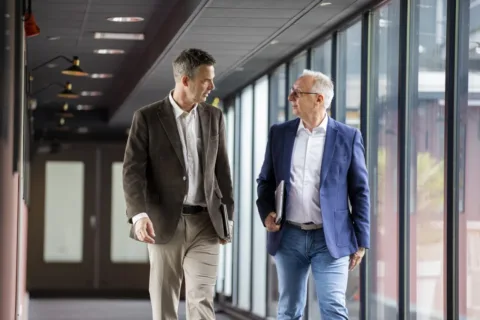
This week, spend an hour shadowing someone. Walk alongside them without judgement and simply try to understand what that person needs to get the job done. Ask what gets in their way the most, and listen without jumping in with an answer. Don’t mention strategy or the plan behind it. Chances are you’ll discover something you can act on the very next day.

Went for a walk and found something you can't let go of?

Then let’s work out the first step that gets things moving, together.

Founder Werner van Keulen